Website security audit services
A one-off check of your WordPress site’s plugins, logins, backups, settings and security headers, with a clear report rated by risk, and the fixes done and checked.
- Fiverr ProVetted
- Top Rated Seller
- 4.9 from 350+ reviews
On this page10 sections
- What a website security audit checks
- Your website security audit report
- WordPress security audit
- How a website security audit works
- Signs you need a security audit now
- Hacked already? Hacked website repair
- How much does a website security audit cost?
- Website security audits in Australia
- Security audits for clients worldwide
- Common questions
A website security audit finds the weak spots in your site before someone else does. I check your plugins, logins, backups, settings and security headers, rate every issue by risk in a clear report, and then fix what I find. My website security audit services suit small businesses whose WordPress site hasn’t had a proper check in a while, or that just feels off. I’m Jay, a freelance web developer in Melbourne and a Fiverr Pro.
What a website security audit checks#
- Plugins and themes: known security flaws, abandoned plugins and ones you no longer use.
- WordPress and PHP versions: whether they’re up to date and still get security fixes.
- Logins and user roles: old or shared admin accounts, two-factor login and limits on password guessing.
- Files and settings: file permissions, debug mode, the public user list and files that give away your WordPress version.
- HTTPS and security headers: HSTS, script rules (a Content-Security-Policy) and protection against framing.
- Backups: whether you have recent copies off-site that actually work when you restore them.
- Malware and spam: injected code, hidden links, strange redirects and spam pages in Google.
- Forms: spam protection, and where the data people send you ends up.
In short, it’s a website vulnerability assessment written for a business owner, so you know what each problem means without the jargon.
Your website security audit report#
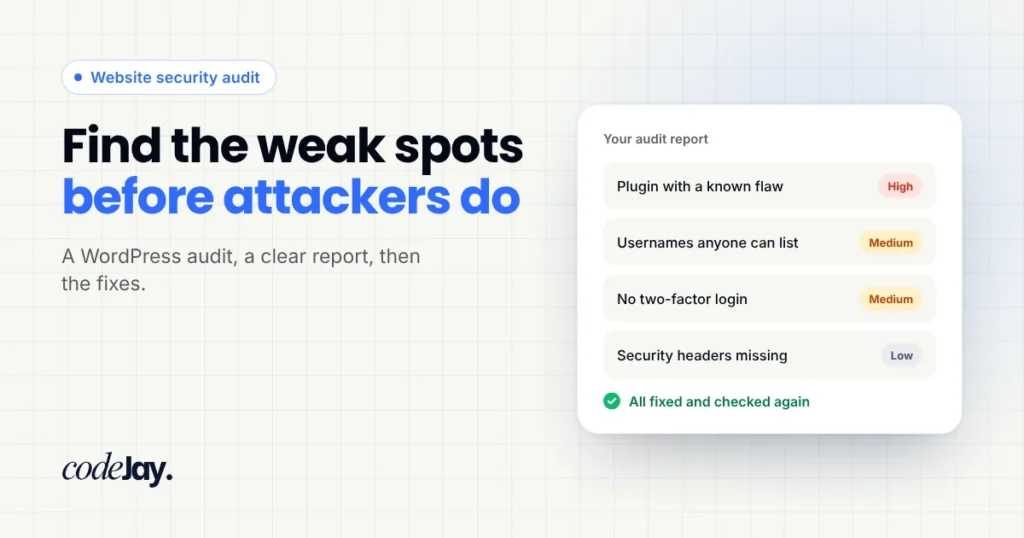
You get a short report that rates every issue by risk, explains it in clear words and says what I’ll do about it:
| Risk | What it means | Example |
|---|---|---|
| High | Fix now, because someone could take over the site or steal data | A plugin with a known flaw that attackers are already using |
| Medium | Fix soon, because it makes an attack easier | Usernames anyone can list, or no two-factor login |
| Low | Good practice that closes small gaps | Missing security headers, or a file that shows your WordPress version |
Then I fix the issues we agree on and check the site again, so the report ends with a clean before-and-after.
WordPress security audit#
Most WordPress problems start in plugins. Patchstack found 11,334 new security flaws in the WordPress ecosystem in 2025, and 91% of them were in plugins, while WordPress itself had only six. Also, 46% had no fix available when the flaws became public, and attackers went after the most popular ones within a median of five hours (Patchstack, February 2026).
That’s why a WordPress security audit starts with your plugin list. Every plugin you remove is one less thing to keep patched. I explain the basics in Is my WordPress website safe?
How a website security audit works#
- Brief. First, send me your website address on Fiverr, and tell me anything that seems wrong.
- Access. Next, you create a temporary admin account for me, which you delete when we’re done. Never send me your own password.
- Audit. Then I check your plugins, settings, files, logins, backups and headers, without changing anything yet.
- Report. After that, you get the report with every issue rated by risk, plus my plan to fix them.
- Fixes and re-check. Finally, I fix what we agreed on, test the site and run the checks again.
Signs you need a security audit now#
- Google shows a warning, or your host has emailed you about malware.
- Visitors end up on strange sites, or spam pages show up when you search for your business.
- The site has suddenly become slow, or new admin users have appeared.
- Your forms send spam, or your emails land in junk.
- Your plugin list is long, and some plugins haven’t had an update in a year or more.
- Someone who had access (a past developer or staff member) has moved on.
Hacked already? Hacked website repair#
If someone has already hacked your site, the first job is a clean-up. My website malware removal service removes the malicious code and users, closes the gap that let the attacker in and updates everything. Then I change the passwords and keys, and ask Google to review the site so the warning goes away. After that, the audit makes sure it doesn’t happen again.
For ongoing care (tested updates, backups and monthly checks), see website maintenance.
How much does a website security audit cost?#
Prices depend on the size of the site and whether someone has already hacked it. For example, agencies list one-off audits at about $2,800 USD, or $4,300 for a hacked site. Even so, most small businesses can get a solid result for well under $10,000, and a freelancer costs less again.
| Option | Typical cost (USD) |
|---|---|
| Agency security audit | $2,800 one-off |
| Agency audit of a hacked site | $4,300 one-off |
| Urgent hacked-site clean-up | $300 an hour |
| Security plugin you run yourself (such as Wordfence) | From $119 a year |
A freelance website security audit usually costs less than an agency one, because you pay one person. My own packages are listed on my Fiverr gig: $120 for the audit and malware scan with a report ranked by risk, $300 with the critical fixes and a retest, and $600 with every issue fixed plus 30 days of care. You see the fixed price before any work starts.
Website security audits in Australia#
Australia’s cyber agency, ASD, received over 84,700 cybercrime reports in 2024-25, about one every six minutes. On average, each report cost a small business $56,600 AUD, which is 14% more than the year before (Minister for Defence, October 2025). Compared with that, an audit is cheap insurance. If something does go wrong, report it through ReportCyber at cyber.gov.au.
Also, Fiverr adds 10% GST to orders from Australian buyers, unless you add a valid ABN and confirm that you’re registered for GST.
Security audits for clients worldwide#
I work from Melbourne, Australia, with clients in Australia, the US, the UK and around the world. Because everything runs through Fiverr, your time zone doesn’t matter. Messages, files and payments stay in one place, and Fiverr only releases payment to me when your order is complete.
Common questions#
How often should I get a website security audit?#
Once a year suits most small business sites. Also get one after a big change, such as a redesign, new plugins or a developer leaving. If your site takes payments or stores customer details, every three to six months is safer.
Will my website go offline during the audit?#
No. The audit only reads your settings and files. When I make fixes such as plugin updates, I test them on a copy first where possible, so visitors don’t notice a thing.
Is a security audit the same as a penetration test?#
No. A penetration test is a formal, simulated attack by a certified tester, often needed for compliance in areas like finance, health or government work. My audit is a hands-on review and hardening of your website: plugins, settings, access, headers, backups and malware signs. If you need a certified penetration test, I’ll tell you, and the audit clears the common issues first.
What access do you need?#
A temporary WordPress admin account, and sometimes hosting access to check files and backups. You delete both when we’re done. Please don’t share your own passwords.
Do you fix what you find?#
Yes. The fixes we agree on are part of the order, and I check the site again afterwards. Bigger jobs, such as replacing a plugin that’s no longer maintained, get a separate quote first.
Is there a free website security check?#
My free speed and SEO test covers speed and Google basics, not security. For a quick look yourself, check that WordPress and every plugin are up to date, delete plugins you don’t use and switch on two-factor login. For everything else, book the audit.
Can you audit a site that isn’t WordPress?#
Yes, for HTTPS, security headers, forms and exposed files. However, the deeper plugin and settings checks are for WordPress sites.
What is a website vulnerability assessment?#
It’s another name for the checking part of an audit: finding known weaknesses and rating them by risk. My audit adds the fixes and a re-check, so you end up with a safer site, not just a list.